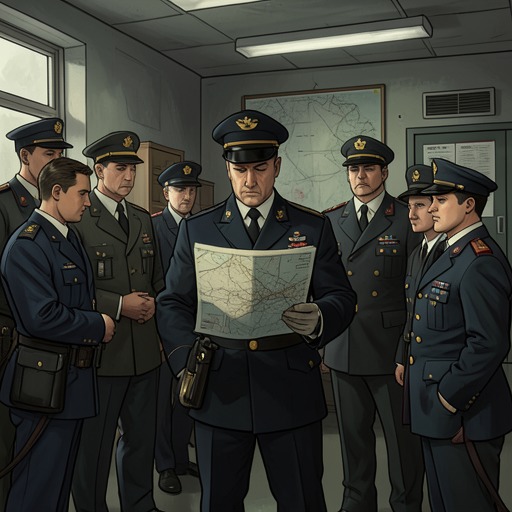
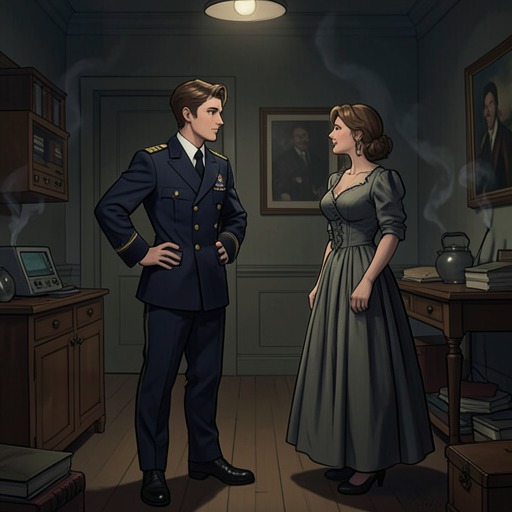
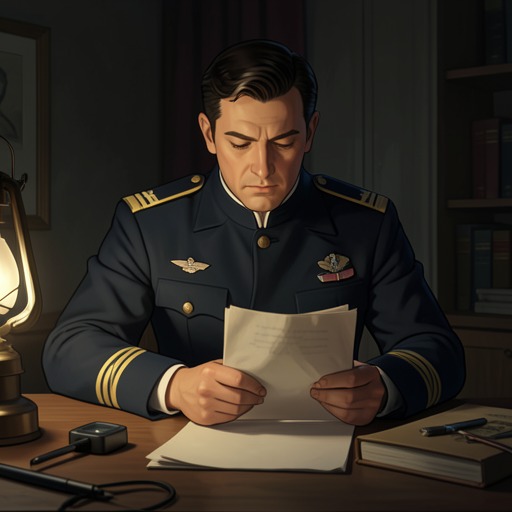
December 1944, in retrospect
A Legal Mutiny
The novel opens by distinguishing the Caine mutiny from a violent revolt: it was a subordinate officer’s legalistic relief of his captain during a typhoon. Articles 184–186 require exceptional circumstances, careful judgment, and readiness to bear responsibility, making the later court-martial a test of both seamanship and military obedience.
The narrator identifies [Willie Keith](entity:character-recall-character-willie-keith-094cf7d72534) as the small personal hinge on which the crisis turns. His character—and the changes the Navy forces upon him—will shape how the events are understood.
December 1942
Willie Enters the Navy
[Willie Keith](entity:character-recall-character-willie-keith-094cf7d72534) leaves his mother outside [Furnald Hall](entity:location-recall-location-70a553827ba2) to begin midshipman training. His mother tries to give him spending money, but the Navy chief tells her that her son will soon be paid; the threshold feels to Willie like stepping through a looking glass into an unfamiliar world.
Physical examinations nearly end his naval prospects over a hollow back and a racing pulse. At a Navy Yard recheck, he persuades the doctor that he truly wants to serve, and the doctor passes him.
Spring 1942
Willie Meets May
Before the Navy, Willie had spent the war’s early months absorbed in his nightclub work. On the day he first earns a better engagement, news of the attack on [Pearl Harbor](entity:location-recall-location-pearl-harbor-03ca7d7f55af) scarcely disrupts his private ambitions; his mother also discourages him from volunteering.
At the [Club Tahiti](entity:location-recall-location-club-tahiti-46906883bdd3), Willie accompanies [May Wynn](entity:character-recall-character-may-wynn-6af305920f66) as she sings Mozart. He is captivated, takes her to dinner, and begins a romance, even while assuming her background makes marriage impossible.
Spring to autumn 1942
A Romance on Willie’s Terms
Willie and May spend the months together in museums, restaurants, walks, and letters. May works and supports her family; Willie enjoys the relationship while carefully avoiding a serious commitment and keeping her existence from his mother.
When his draft notice arrives, Willie chooses the Navy as a way to avoid the Army and secure a commission. His mother takes him on trips before training, while May continues singing and their bond deepens without resolving its future.
December 1942 to early 1943
The Midshipman’s Narrow Escape
At [Furnald Hall](entity:location-recall-location-70a553827ba2), Willie shares a room with the anxious [Edwin Keggs](entity:character-recall-character-edwin-keggs-36ddb8669d62) and the irreverent [Roland Keefer](entity:character-recall-character-roland-keefer-700b146cf386). He nearly ruins his chances by losing a rifle spring out a tenth-floor window, then risks a dangerous climb to retrieve it before an ensign catches the roommates.
A lucky examination answer gives Willie a reputation for ordnance knowledge, and all three roommates survive the school’s elimination process. Yet Willie’s romantic indecision returns when he spends precious leave with his family instead of remaining with May.
Early 1943
May Ends the Romance
After Willie misses curfew and accumulates more demerits, May tells him that she will not remain a temporary diversion while he avoids deciding whether to marry her. She even offers to attend college, but Willie cannot answer her hope with a commitment.
May breaks away, then appears at the school review and signals that he has won her back. Distracted, Willie follows the wrong marching order and is nearly expelled, but [Commander Merton](entity:character-recall-character-commander-merton-72777dbbcad4) lets him stay under strict confinement and a final demerit limit.
Early 1943
Willie Chooses the Navy
During confinement, Willie learns that his mother is exploring an Army commission through family connections. He asks his father to call off the plan and declares that if he fails out of the Navy he will enlist as a sailor rather than transfer.
His father recognizes the resolve as a real change in his son. May visits discreetly, resumes her studies, and Willie works hard enough to graduate, though he remains far from the top of the class.
Spring 1943
Orders to the Caine
Graduates are asked to rank their preferred assignments. Willie chooses shore-oriented work because he wants to remain near May; [Edwin Keggs](entity:character-recall-character-edwin-keggs-36ddb8669d62) puts minesweeping among his choices despite fearing it, while [Roland Keefer](entity:character-recall-character-roland-keefer-700b146cf386) requests Pacific staff duty.
Keggs receives orders to the Moulton, and Willie receives orders to the Caine, an obsolete destroyer-minesweeper. The assignment feels like an undeserved punishment after his hard-won graduation.
Spring 1943
Willie’s Father’s Last Letter
In [San Francisco](entity:location-recall-location-san-francisco-8a14902ce523), Willie parties with [Roland Keefer](entity:character-recall-character-roland-keefer-700b146cf386) and delays pursuing his ship after missing it in [Pearl Harbor](entity:location-recall-location-pearl-harbor-03ca7d7f55af). An admiral enjoys Willie’s songs and helps arrange a comfortable temporary billet in the officer pool.
Willie finally opens the letter his father told him to read when he reached the Caine. [Dr. Keith](entity:character-recall-character-dr-keith-5af7f6086f23) reveals that he is dying of cancer, reflects on the life he failed to pursue, and urges Willie to use his time well and become a man.
September 1943
Willie Reports Aboard
After learning that his father has died, Willie rejects the comfort of his temporary shore assignment and asks to join the Caine. When he finally reports aboard, he finds a filthy, crowded ship and officers and sailors who seem to treat disorder as a way of life.
[Captain de Vriess](entity:character-recall-character-captain-de-vriess-dac136bea1bb) is introduced to Willie in his underwear, and the new ensign is given a bunk in a hot clipping shack. He meets [Tom Keefer](entity:character-recall-character-tom-keefer-2b828cd4cb56), a literary officer who is brilliant at communications but cynical about routine Navy work.
September 1943
The Caine’s First Lessons
Willie’s first watches expose the Caine’s lax habits: sailors sleep on watch, and the new ensign is unsure how much discipline to enforce. Lieutenant Adams explains that the ship has spent years on demanding forward-area assignments, even if its worn condition makes it look neglected.
Willie’s resentment of [Captain de Vriess](entity:character-recall-character-captain-de-vriess-dac136bea1bb) grows when the captain mocks his exhaustion and makes him finish paperwork before shore leave. Still, Willie begins to see that the old captain knows the ship and can handle it at sea.
September 1943
The Lost Action Dispatch
Willie receives an action dispatch during the recovery of a lost paravane float and forgets it in his wet clothes. Three days later [Captain de Vriess](entity:character-recall-character-captain-de-vriess-dac136bea1bb) discovers the missing message, which ordered his own detachment and the immediate arrival of Commander Queeg.
[De Vriess](entity:character-recall-character-de-vriess-74facb58260d) gives Willie a damaging fitness report and confines him to the ship, but the ensign is more wounded by the report than by the punishment. A delayed package from his father contains a Bible and the verse urging him to do his work with all his might; Willie gives up an admiral’s invitation and stays aboard.
Late September 1943
Queeg Takes Command
[Philip Francis Queeg](entity:character-recall-character-philip-francis-quee-2e3a47e7fb8f) arrives without warning and assumes command after a brief handover. [Captain de Vriess](entity:character-recall-character-captain-de-vriess-dac136bea1bb) tells him the Caine is a difficult, worn ship whose crew can deliver results despite its rough habits, but Queeg takes charge quickly and insists on paperwork, inspections, and strict standards.
Before leaving, de Vriess accepts a farewell watch from the crew, pretending it has been left behind. Queeg is released from his predecessor’s confinement of Willie, but immediately starts tightening discipline.
Late September 1943
The New Order
Queeg tells the wardroom that the ship will operate by his rules and the book, demanding upward loyalty and excellent performance. He makes Willie the morale officer and orders sailors to tuck in their shirttails, turning a minor uniform detail into a test of command.
Queeg also imposes tighter watches and searches for errors in every department. The crew outwardly complies while continuing many old habits beyond his sight, creating the quiet divide later described as the [Circle of Compliance](entity:expression-recall-expression-circle-of-complian-5e13ed5089d0).
September 1943
Grounding at West Loch
On the Caine’s first departure under Queeg, the ship backs into a neighboring vessel, tears into its fittings, and runs aground in [West Loch](entity:location-recall-location-west-loch-5294b17a9442). Queeg quickly gets a tug to pull the Caine free and decides not to report the grounding until ordered.
A subsequent message demands an explanation. Queeg sends a report blaming delayed engine-room response and presenting the incident as evidence of poor training, though he does not mention his own handling. The episode establishes his instinct to protect his record by reshaping responsibility.
Late September 1943
The Caine’s Orders Change
The Caine’s orders to proceed to [Pago Pago](entity:location-recall-location-pago-pago-1f582743bab5) are canceled, and it is assigned to target towing at [Pearl Harbor](entity:location-recall-location-pearl-harbor-03ca7d7f55af). Queeg initially accepts the change, then grows suspicious that the grounding caused the reassignment and sends Gorton to seek an explanation.
The visit to [ComServPac](entity:organization-recall-organization-comservpac-da4e465a9484) goes badly, and Queeg insists that the crew tuck in its shirts and that officers attend further meetings. His anxiety about evaluation begins to drive his increasingly rigid command style.
Autumn 1943
The Foggy Channel
Queeg takes the Caine out through dense fog despite initially deciding to wait for it to clear. When the fog thickens, he panics, runs around the bridge, and berates the helmsman, although the ship avoids a collision with a tanker and a battleship.
The crew sees that Queeg’s confidence can collapse under pressure. Willie and the others begin to question whether strictness alone can make the Caine safe.
Autumn 1943
The Lost Target
During target towing, Queeg turns the Caine in a circle while berating his officers over a sailor’s shirttail. The ship crosses its own towline and loses the target, but Queeg blames defective equipment and refuses [Maryk](entity:character-recall-character-41c7d2ef13bf)’s offer to recover it.
A reprimand from [Captain Grace](entity:character-recall-character-aff3d72d5e06) calls the incident a fiasco. Queeg will not admit that he cut the towline, and instead blames Gorton for failing to advise him, beginning a cycle of fear and self-protection in the wardroom.
Autumn 1943
A Fitness Report and a Sunk Crate
Queeg repeatedly makes Willie and [Tom Keefer](entity:character-recall-character-tom-keefer-2b828cd4cb56) write formal reports over the shirttail incident, turning routine paperwork into a disciplinary weapon. He also takes a large crate of personal goods ashore; it slips from the gig and sinks while Willie is boat officer.
Queeg holds Willie responsible and accepts his offer to repay the loss before granting leave. The crate is in fact filled with liquor, a fact that will later undermine Queeg’s credibility under oath.
Late 1943
The Caine Returns to San Francisco
The Caine is ordered back to the United States for overhaul, a coveted assignment that de Vriess never secured. The crew celebrates the prospect of home leave, while Queeg’s arrival in [San Francisco](entity:location-recall-location-san-francisco-8a14902ce523) brings Willie’s mother and May together at the pier.
Willie introduces May by her real name, Marie Minotti, revealing his shame about her working-class family. During leave at [Yosemite](entity:location-recall-location-a1849e38d09c), he and May sleep together and he proposes, but his mother persuades him that guilt and desire are not a sound basis for marriage.
Late 1943, during the San Francisco leave
Willie Hesitates Over Marriage
Willie’s mother argues that May’s background and religion do not fit the cultivated future she imagines for him. Willie recognizes that he is ashamed of May’s origins and uncertain about his motives, but cannot bring himself to end the relationship decisively.
He and May part without a firm engagement, each still attached to the other. The unresolved choice will haunt Willie through the months at sea.
Late 1943, during the overhaul
Stilwell’s Emergency Leave
A telegram says [John Stilwell](entity:character-recall-character-john-stilwell-ac5ce4dcbe17)’s mother is gravely ill, and the sailor asks for emergency leave. Willie believes the real motive is [Stilwell](entity:character-recall-character-stilwell-2ceafdb088b1)’s fear for his marriage, but urges [Maryk](entity:character-recall-character-41c7d2ef13bf) to let him go; Maryk finally grants a seventy-two-hour pass without Queeg’s approval.
Stilwell returns late, and Queeg demands an inquiry and threatens Maryk’s fitness report. Although Maryk regrets disobeying the captain, the incident deepens his unease about the difference between following orders and doing what seems humane.
December 1943
The Caine Sails Back to War
The overhaul is abruptly curtailed, and the Caine sails back to the Pacific short-handed. [Maryk](entity:character-recall-character-41c7d2ef13bf) becomes executive officer, while Queeg increases paperwork, inspections, punishments, and restrictions on the crew.
The ship returns to the forward area with a crew that has learned to comply in Queeg’s presence and ignore many of his rules elsewhere. Willie is now an established officer, but remains caught between the captain and the wardroom’s growing hostility.
January 1944
The Invasion of Kwajalein
The Caine joins the [Northern Attack Force](entity:organization-recall-organization-northern-attack-8d3f7be08249) for the invasion of [Kwajalein](entity:location-recall-location-kwajalein-b615f1e62236). Willie’s first combat experience is initially distant and almost unreal, as ships and planes bombard the atoll before the landing boats approach.
Queeg is assigned to guide Jacob Group Four’s landing craft, but moves ahead, misjudges the bearings, and drops a yellow marker while turning away. The Caine leaves the boats to find the departure line themselves, giving [Tom Keefer](entity:character-recall-character-tom-keefer-2b828cd4cb56) fresh grounds for calling the captain a coward.
January 1944
The Caine’s Combat Routine
The Caine remains near the devastated islands, while Willie watches bombardments and listens to Marines under fire. He is troubled by the distance between the men dying ashore and the officers eating ice cream aboard ship, but continues to observe rather than intervene.
Queeg’s reprimands and rigid demands continue even during the invasion. Willie’s understanding of war grows, though his experience is still filtered through routine watches and the ship’s closed world.
Early 1944, en route to Funafuti
The Caine’s Water Famine
After the crew’s water use rises during the invasion, Queeg imposes a forty-eight-hour ban on personal water. In hot, still weather, stack gas and cabbage fumes trap the ship in stifling air; sailors sleep on deck and secretly draw water from the engine room.
When Queeg catches an officer showering, he extends the restriction to the wardroom. Willie’s attempt to argue for [Stilwell](entity:character-recall-character-stilwell-2ceafdb088b1)’s leave and the crew’s welfare ends in seasickness, while [Maryk](entity:character-recall-character-41c7d2ef13bf) increasingly struggles to enforce orders he considers destructive.
Early 1944, at Funafuti
Willie Finds a Different Navy
At Funafuti, Willie visits the tender Pluto and encounters clean spaces, plentiful food, and an efficient communications office. He meets his former drill instructor, Ensign Acres, now an officer who admits that comfortable service can be both useful and welcome.
Willie is promoted to lieutenant junior grade. He considers reporting Queeg’s water abuse to a chaplain but decides that he cannot abandon the Caine’s people or evade his own responsibilities.
Early 1944
Stilwell’s Court-Martial
Queeg orders Willie to serve as recorder in [Stilwell](entity:character-recall-character-stilwell-2ceafdb088b1)’s summary court-martial and predicts that the sailor will receive a bad-conduct discharge. Willie discovers from the [Courts and Boards](entity:object-recall-object-courts-and-boards-08ab9c3969c8) manual that Stilwell can repudiate his confession and plead not guilty.
Queeg pressures Stilwell to reaffirm the confession, and the sailor gives in. At trial, [Keefer](entity:character-recall-character-0ee352499f7e) and the other officers find Stilwell guilty but impose only the loss of six liberties, a sentence that openly defies Queeg’s demand for harsher punishment.
Early 1944
Maryk Keeps a Secret Log
After the court-martial, [Keefer](entity:character-recall-character-0ee352499f7e) tells [Maryk](entity:character-recall-character-41c7d2ef13bf) that Queeg may be mentally ill and describes him as paranoid. Maryk rejects the diagnosis at first, then privately begins recording the captain’s behavior in a secret medical log.
When he confronts Keefer and asks him to support a report to higher authority, Keefer backs away, warning that the Navy will treat them as mutineers. Maryk nonetheless continues documenting what he sees as a growing pattern.
June 1944
The Saipan Shore Battery
During the [Saipan](entity:location-recall-location-saipan-039eb4535782) campaign, the Caine patrols near the island when a shore battery opens fire on the destroyer Stanfield. Willie sees the ship being straddled and urges Queeg to bring the Caine around and fire in support.
Queeg turns away instead. [Maryk](entity:character-recall-character-41c7d2ef13bf) records the episode in his secret log, and Willie’s confidence in the captain’s courage and judgment is badly shaken.
Summer to autumn 1944
Life Under Queeg
The Caine resumes dull escort work, and Queeg’s increasingly frequent inspections and punishments become part of daily life. Willie is singled out as the captain’s new target, but responds by making his own communications work increasingly accurate and by refusing to blame his incompetent assistant, Ducely.
The officers wait anxiously for Queeg’s transfer orders. The pressure of fatigue, isolation, and boredom produces eccentric behavior across the ship, while Willie’s letters to May become passionate but evasive about marriage.
October 1944
Roland Keefer Dies at Leyte
At [Ulithi](entity:location-recall-location-ulithi-f23668ac4c2f), Willie and [Tom Keefer](entity:character-recall-character-tom-keefer-2b828cd4cb56) see [Roland Keefer](entity:character-recall-character-roland-keefer-700b146cf386) aboard the carrier Montauk as the fleet heads toward the [Philippines](entity:location-recall-location-8b86fdcbfca5). During the [Battle of Leyte Gulf](entity:event-recall-event-64442bb07070), a Japanese plane strikes the carrier, and Roland directs damage control and helps save the ship.
Roland later dies of burns and pneumonia. Tom grieves the brother he had dismissed as less intellectual, and Willie struggles to reconcile the irreverent roommate he knew with the courage Roland showed in battle.
Autumn 1944
The Strawberry Investigation
After a gallon of strawberries disappears from the wardroom, Queeg wakes the officers in the night to conduct a detailed accounting. Convinced that a duplicate key must exist, he orders every key on the ship collected and plans a humiliating search of the crew.
Ducely admits to Willie that he saw the mess boys eat the berries, and the yeoman confirms the story. Queeg rejects the evidence and continues the search, exposing how thoroughly his need to prove himself has overtaken ordinary judgment.
Autumn 1944
The Search Fails
The Caine’s crew is stripped and searched in bad weather while thousands of tagged keys are tested against the wardroom lock. Queeg withdraws from the operation, but insists that it continue despite the lack of evidence for his theory.
When the search finds nothing, [Maryk](entity:character-recall-character-41c7d2ef13bf) reads his accumulated log and asks [Keefer](entity:character-recall-character-0ee352499f7e) to accompany him to report Queeg to higher authority. Keefer agrees, but changes his mind when they reach Halsey’s flagship, leaving Maryk to face the decision alone.
December 1944
A Typhoon Approaches
As the Caine leaves [Apra Harbor](entity:location-recall-location-apra-harbor-9b9c545a8526) with damaged ships, Willie notices a falling barometer and begins plotting storm warnings. Queeg initially dismisses his concerns, then orders the chart checked after a newly received warning reveals a nearby disturbance.
The fleet tries to refuel at sea despite worsening weather, then turns south to escape. The Caine follows its orders into the storm, with Willie on watch and Queeg increasingly tense about the ship’s position and performance.
December 18, 1944
The Typhoon Turns
As the typhoon intensifies, wind and waves make the Caine yaw and roll beyond the crew’s experience. Queeg orders a course that leaves the ship broadside to the storm; when the ship begins to broach, he freezes on the engine telegraph and rejects [Maryk](entity:character-recall-character-41c7d2ef13bf)’s request to ballast.
A huge roll throws water into the bridge, the gyro and lights fail, and the Caine is nearly capsized. Maryk takes the engines from Queeg and turns the ship into the wind, bringing it upright.
December 18, 1944
Maryk Relieves Queeg
With the Caine temporarily riding upright, Queeg again orders a return to fleet course despite the loss of contact and the ship’s danger. [Maryk](entity:character-recall-character-41c7d2ef13bf) concludes that the captain is no longer capable of command and relieves him under Article 184, taking responsibility himself.
Willie backs Maryk’s orders, and the officers follow the new command. The ship circles a capsized destroyer and rescues survivors, including men from the George Black, while Queeg remains on the bridge insisting that he is still captain.
After the typhoon, early 1945
Maryk Faces a Court-Martial
After the Caine returns to [Ulithi](entity:location-recall-location-ulithi-f23668ac4c2f), the Navy’s medical officers find no conclusive evidence that Queeg is insane. [Maryk](entity:character-recall-character-41c7d2ef13bf) is sent to [San Francisco](entity:location-recall-location-san-francisco-8a14902ce523) to face a general court-martial, and Willie is also recommended for trial; [Stilwell](entity:character-recall-character-stilwell-2ceafdb088b1) suffers a breakdown and is hospitalized.
[Barney Greenwald](entity:character-recall-character-barney-greenwald-ad81a87904ca) reluctantly agrees to defend Maryk. He warns that the case is dangerous and that Maryk may have acted from a sincere but legally mistaken belief that Queeg was unfit for command.
Early 1945, before Maryk’s trial
Willie Returns to May
On leave in New York, Willie tells his mother about the relief of Queeg and learns that she still hopes the Navy will spare him. He intends to end things with May, but when he reaches her he finds her exhausted, ill, and supporting her family while trying to continue her education.
Willie finally tells May that their relationship is over. He leaves without explaining the court-martial, and then avoids her for the rest of his leave, retreating into his mother’s company and the familiar comforts of home.
Early 1945
The First Day of Trial
At [Maryk](entity:character-recall-character-41c7d2ef13bf)’s court-martial, Queeg appears polished and confident. He describes the typhoon as a situation he controlled until Maryk panicked and seized command, and portrays Willie and [Stilwell](entity:character-recall-character-stilwell-2ceafdb088b1) as disloyal men who helped the mutiny.
[Tom Keefer](entity:character-recall-character-tom-keefer-2b828cd4cb56) testifies that he had known about Maryk’s suspicions but had warned him not to act. He denies that the log justified relief, strengthening the prosecution and leaving Maryk bewildered by his former friend’s testimony.
Second day of Maryk’s trial
Willie Takes the Stand
[Challee](entity:character-recall-character-challee-ec8677eb29dd) questions Willie about his dislike of Queeg, his earlier support for [Stilwell](entity:character-recall-character-stilwell-2ceafdb088b1), and the long list of punishments and restrictions aboard the Caine. Willie admits that he disliked Queeg and cannot honestly say whether his obedience to [Maryk](entity:character-recall-character-41c7d2ef13bf) came only from a belief that the captain was mentally ill.
Under Greenwald’s questioning, Willie describes Queeg’s conduct under fire, including the retreat from the [Saipan](entity:location-recall-location-saipan-039eb4535782) battery and the disputed [Kwajalein](entity:location-recall-location-kwajalein-b615f1e62236) marker. The testimony reframes the issue from diagnosis alone to the captain’s judgment and courage in command.
Second day of Maryk’s trial
Psychiatrists Examine Queeg
The Navy psychiatrists testify that Queeg is not psychotic and was fit for duty. Greenwald draws out their descriptions of Queeg’s insecurity, rigidity, suspicion, and paranoid features, showing that a man might be considered mentally sound in an interview yet perform badly under extreme command stress.
[Dr. Bird](entity:character-recall-character-dr-bird-43b274a83848) concedes that Queeg has a disturbed personality and that an intensified condition could disable him. The court now has to judge the difference between a diagnosis on shore and the realities of command in a typhoon.
Third day of Maryk’s trial
Queeg’s Credibility Breaks
Greenwald cross-examines Queeg about his offer to erase the relief from the logs, then confronts him with the liquor crate he had denied owning. Queeg changes his account, admits that the crate contained liquor, and struggles to explain the conflicting story.
Questioned about the towline and his conduct during the [Kwajalein](entity:location-recall-location-kwajalein-b615f1e62236) and [Saipan](entity:location-recall-location-saipan-039eb4535782) operations, Queeg rambles through grievances against his officers. His own fitness reports had praised [Maryk](entity:character-recall-character-41c7d2ef13bf) as loyal, courageous, and qualified for command, contradicting his claim that Maryk had long been disloyal.
After the trial
Maryk Is Acquitted
[Challee](entity:character-recall-character-challee-ec8677eb29dd) argues that allowing subordinates to remove a captain would endanger the Navy’s chain of command. Greenwald answers that the case turns on whether [Maryk](entity:character-recall-character-41c7d2ef13bf) had justifiable cause and whether Queeg could command safely under the stress of the typhoon.
After deliberating for just over an hour, the court acquits Maryk. The Caine officers celebrate, and [Keefer](entity:character-recall-character-0ee352499f7e) announces that a publisher has accepted his novel, presenting the occasion as both a legal victory and the beginning of his literary career.
The night of Maryk’s acquittal
Greenwald Confronts Keefer
At a champagne dinner celebrating the verdict and [Keefer](entity:character-recall-character-0ee352499f7e)’s book deal, Greenwald arrives drunk and refuses the toast to the novelist. He says that Keefer helped turn the wardroom against Queeg, encouraged [Maryk](entity:character-recall-character-41c7d2ef13bf) to think in terms of paranoia, and then abandoned him when the consequences became real.
Greenwald admits that he defended Maryk by attacking Queeg, even though he believes Queeg deserved a fairer defense. He throws wine in Keefer’s face, accusing him of keeping his own reputation clean while others accepted the risk.
Late June 1945
A Kamikaze Hits the Caine
With [Keefer](entity:character-recall-character-0ee352499f7e) now captain and Willie his executive officer, a Kamikaze strikes the Caine near [Okinawa](entity:location-recall-location-okinawa-fc57eb168687). The plane crashes into the deck over the after fireroom, killing Horrible and starting a dangerous fire amid ammunition and damaged machinery.
Keefer orders the crew to abandon ship, takes his manuscript, and jumps into the sea. Willie sees that the main deck is not being abandoned and decides to remain aboard with volunteers to save the ship.
The day of the Kamikaze attack
Willie Saves the Ship
Willie restores power to the public-address system, organizes the fire parties, and gives clear instructions to the engine room and gun crews. The sailors return to their drills, and the fire is contained before it reaches the magazines.
Willie takes the Caine through a rescue search and accounts for the crew. Horrible’s body is recovered from the flooded fireroom, and the experience leaves Willie newly conscious of death, luck, and the value of living.
After the Kamikaze attack
Keefer’s Shame
[Keefer](entity:character-recall-character-0ee352499f7e) returns aboard injured and shaken, grateful that Willie has saved the Caine. He asks Willie to reassure Commodore Wharton that his decision to abandon ship was understandable, but Willie is unable to call it anything other than a failure of courage.
Keefer admits that he will never escape the knowledge that he jumped. He gives Willie part of his manuscript, and Willie writes to May that night, finally asking her to marry him.
Summer 1945
The Caine Is Left Behind
The Caine’s damaged boiler cannot be repaired quickly, and the ship waits at [Okinawa](entity:location-recall-location-okinawa-fc57eb168687) while more useful vessels receive attention. Willie worries as weeks pass without an answer from May, though he knows the mail system is functioning.
When the atomic bomb and then the Soviet declaration of war against Japan are announced, the crew begins to believe the war is ending. The Caine remains stranded and misses the minesweeping operation in Tokyo Bay.
August 10, 1945
Japan Surrenders
Willie hears the announcement of Japan’s surrender on the radio and realizes that he has survived the war. Celebrations erupt around the harbor, and the Caine’s crew fires its anti-aircraft guns in the general jubilation.
The end of war also sharpens Willie’s sense of what he has lost and what remains unsettled. He is still waiting for May’s answer and must decide what kind of life he wants after the Navy.
September 1945
A Captain’s Command
A Navy discharge-points system releases half the Caine’s crew and gives [Keefer](entity:character-recall-character-0ee352499f7e) an opportunity to leave. Willie is assigned command after Keefer argues that he has earned it, and he receives the orders with pride mixed with disbelief.
Keefer departs quickly, admitting that the Caine has become an object of hatred for him. He warns Willie not to envy his freedom too much and confesses that he jumped when the ship was in danger.
After Willie becomes captain
Willie Rides Out a Typhoon
A typhoon approaches [Okinawa](entity:location-recall-location-okinawa-fc57eb168687), and Willie, newly responsible for the Caine, asks [Edwin Keggs](entity:character-recall-character-edwin-keggs-36ddb8669d62) to accompany him back to sea rather than risk remaining at anchor. The Caine survives a storm that wrecks other ships in the harbor.
Willie stays on the bridge for thirty hours, maneuvering the ship and holding the anchor. His performance wins the crew’s respect and establishes him as a capable captain.
On the return voyage from Okinawa
A Medal and a Reprimand
The Caine receives orders to return to the United States for decommissioning. At [Pearl Harbor](entity:location-recall-location-pearl-harbor-03ca7d7f55af), Willie finds a [Bronze Star](entity:object-recall-object-bronze-star-191cae0991d9) citation for saving the ship after the Kamikaze attack and, in the same batch of mail, a formal reprimand for supporting [Maryk](entity:character-recall-character-41c7d2ef13bf)’s relief of Queeg.
The contradictory honors settle the Navy’s view of him: his courage in the emergency is recognized, but his judgment in the mutiny is officially condemned. Willie places both documents together in his record, leaving the inconsistency for future generations to interpret.
October 27, 1945
The Caine Is Decommissioned
At [Bayonne](entity:location-recall-location-2aceed9a5c19), the Caine is stripped of its weapons and formally decommissioned. Willie lowers the flag and gives a farewell speech to the dwindling crew, calling the ship’s ordinary escort and support work a necessary part of winning the war.
He leaves the vessel with no colors to salute and no officer of the deck to relieve him. His mother waits in her Cadillac, but Willie is no longer the boy she once escorted to the Navy’s gates.
After the Caine’s decommissioning
Willie Finds May Again
Willie tells his mother that he still intends to marry May, and his mother, afraid of losing her son, finally agrees to meet the woman she once opposed. Willie contacts [Marty Rubin](entity:character-recall-character-marty-rubin-a7e8c40b59b5), who takes him to the hotel where May is performing under a new name.
May is now involved with the bandleader [Walter Feather](entity:character-recall-character-walter-feather-6aa43c6a6a5a). Willie is hurt by the change in her appearance and by her relationship, but insists that his feelings are real and asks her to marry him.
Navy Day, after the Caine’s decommissioning
May and Willie Reconsider
May admits that she has not slept with Feather, though he hopes to marry her once his divorce is final. She is still wounded by Willie’s earlier rejection and doubts that his sudden return can undo the damage, but their attraction remains strong.
Willie walks out to watch the [Navy Day](entity:time-recall-time-4b82c4e4b4a6) parade, determined to make May his wife despite uncertainty about their future. The novel ends with him no longer hiding behind class expectations or his mother’s approval, but facing the risk of a life chosen for himself.